Last Updated: [Current Month] 2026 | Read Time: 18 min
Author: WebFX Amazon Marketing Team
Reviewed by: Amazon advertising & marketplace specialists
Powered by strategies behind $10B+ in client revenue
As a new (or growing) Amazon seller, you will encounter dozens of acronyms, metrics, and platform terms every week — ACoS, FBA, ASIN, Buy Box, IPI, TACoS, and more. Misunderstanding even one of them can cost you rankings, ad budget, or account health.
This Amazon glossary is your complete, plain-English reference for 150+ Amazon acronyms, abbreviations, and seller terms. Bookmark it, share it with your team, and use it anytime you need a clear definition — plus practical context on why each term matters for sales, advertising, and operations.
[Primary CTA Button: Download the Free Printable Amazon Seller Glossary PDF]
150+ terms, formulas, and a new-seller cheat sheet. Instant download. No spam.
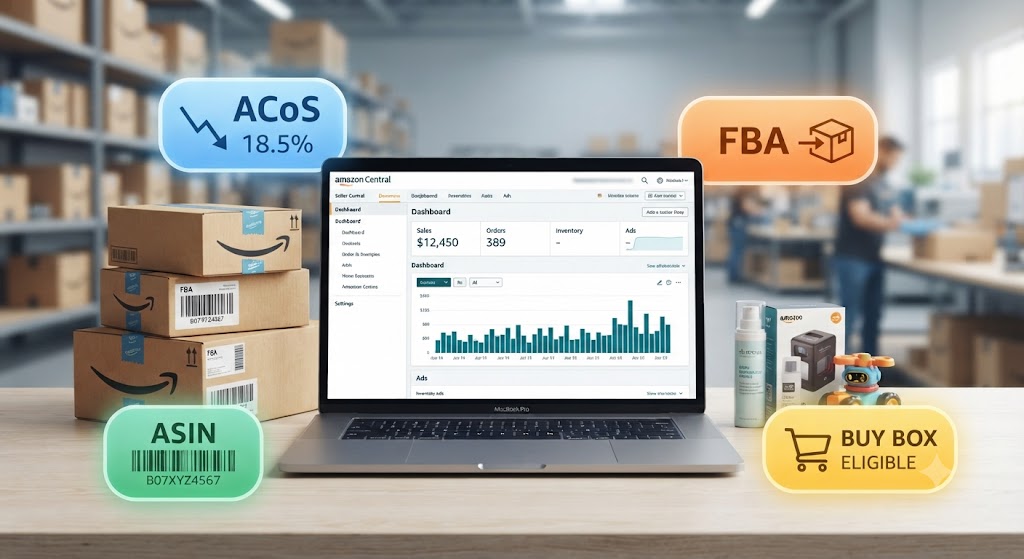
[Image suggestion: Clean hero graphic showing Amazon boxes, a laptop with Seller Central, and floating acronym chips (ACoS, FBA, ASIN, Buy Box) | Alt text: “Amazon glossary guide covering 150+ Amazon seller acronyms and terms for 2026”]
Quick Navigation
- How to Use This Amazon Glossary
- 12 Most Important Amazon Terms for New Sellers
- A–Z Amazon Glossary
- Amazon Glossary FAQs
- Next Steps: Grow Your Amazon Sales
Sticky Alphabet Jump Links:
A B C D E F G H I K L M N O P R S T U V W
How to Use This Amazon Glossary
- Use the alphabet jump links to find a term fast.
- Look for Related terms under major entries to connect concepts (e.g., FBA ↔ FBM ↔ FC).
- Metric terms include the formula, what it measures, and why it matters.
- Click internal links to full guides and WebFX Amazon services when you are ready to go deeper.
Whether you are launching your first listing or scaling a multi-million-dollar brand, this Amazon seller glossary keeps your team aligned on the language of the marketplace.
12 Most Important Amazon Terms for New Sellers
Start here if you are new to Amazon. These terms appear constantly in Seller Central, advertising dashboards, and seller forums.
| Term | Quick Definition | Why It Matters |
|---|---|---|
| ASIN | Amazon’s unique 10-character product ID | How every product is tracked and ranked |
| FBA | Amazon stores, packs, ships, and supports your orders | Unlocks Prime badge and faster delivery |
| FBM | You store, pack, ship, and support orders yourself | More control; no Prime badge unless SFP |
| Buy Box | The “Add to Cart” widget on the product page | Most sales come from the Buy Box winner |
| ACoS | Ad spend ÷ ad sales | Core measure of Amazon ad efficiency |
| TACoS | Ad spend ÷ total sales | Shows ad impact on overall business health |
| BSR | Best Sellers Rank in a category | Lower = higher sales velocity |
| A9 | Amazon’s product search ranking algorithm | Drives organic placement and visibility |
| PPC | Pay-per-click advertising | Primary paid traffic channel on Amazon |
| Brand Registry | Brand protection and A+ Content access | Critical for brand control and defense |
| IPI | Inventory Performance Index | Affects storage limits and fees |
| Seller Central | The dashboard for third-party (3P) sellers | Where you manage listings, ads, and orders |
[CTA: New to Amazon? Get a Free Amazon Account & Listing Audit]
A–Z Amazon Glossary
A {#a}
A+ Content
Amazon’s enhanced content program that lets Brand Registry sellers add richer layouts — comparison charts, lifestyle images, videos, and modules — to the product detail page below the fold. Strong A+ Content can improve conversion rate and brand perception.
Related: Brand Registry, Brand Store, PDP
A9
Amazon’s proprietary search ranking algorithm. A9 evaluates relevance (title, bullets, backend keywords, images) and performance signals (sales velocity, conversion rate, customer reviews, and more) to decide which products appear for a given search query.
Related: Amazon SEO, Backend keywords, BSR, Conversion rate
Internal link suggestion: “How the Amazon A9 Algorithm Works” / Amazon SEO services
A/B Testing
A method of comparing two versions of a listing element (title, main image, A+ module, price) to see which performs better on clicks, conversion, or sales. Amazon Brand Analytics and experiments tools can support structured tests.
Account Health
A Seller Central page that shows how well your account meets Amazon’s performance targets and policies (order defect rate, late shipment rate, cancellation rate, policy compliance). Poor account health can lead to listing removal or account suspension.
ACoS (Advertising Cost of Sale)
A core Amazon advertising metric that measures ad efficiency.
Formula: ACoS = Ad Spend ÷ Ad Sales
Example: $100 ad spend ÷ $400 ad sales = 25% ACoS
Why it matters: Lower ACoS generally means more efficient ads, but the “right” ACoS depends on your margins and growth goals. Many sellers also track TACoS for a fuller picture.
Related: TACoS, RoAS, CPC, PPC, Sponsored Products
Internal link suggestion: Amazon PPC management services / ACoS optimization guide
Ad Daily Budget
The average amount you are willing to spend per day on an Amazon ad campaign. Once the budget is exhausted, ads typically stop serving until the next day (unless you adjust).
Ad Impressions
The number of times your ad was displayed to shoppers, whether or not they clicked.
Ad Orders
The number of orders attributed to shoppers who clicked your ad within Amazon’s attribution window.
Ad Sales
Total product sales attributed to ad clicks over a given period (often reported weekly or in campaign date ranges).
Ad Spend
The total amount charged for clicks (or impressions, for some formats) on your Amazon advertising campaigns.
Ad Status
The current state of an ad group or campaign (e.g., Delivering, Out of budget, Paused, Pending review). Check status first when diagnosing delivery issues.
Ad Targeting
The method used to decide when your ads show. Options include automatic targeting (Amazon matches relevant queries) and manual targeting (you choose keywords, products, or categories).
Affiliate Marketing
A performance model where you pay a commission to partners (including Amazon Associates) for traffic or sales generated through their referral links.
Alibaba
A global B2B marketplace commonly used by private-label sellers to source manufacturers, wholesalers, and suppliers.
Amazon 1P (First-Party)
A supplier relationship in which Amazon is the retailer. Amazon issues purchase orders, takes ownership of inventory, and controls retail pricing. Managed primarily through Vendor Central.
Amazon 2P (Second-Party)
A model in which you control selling your products, but inventory is stored in Amazon warehouses and fulfilled by Amazon. Listings often show “Sold by [Brand], Shipped from Amazon.”
Amazon 3P (Third-Party)
The standard marketplace model in which you sell directly to consumers on Amazon, control pricing and inventory strategy, and use FBA, FBM, or both. Managed through Seller Central.
Amazon 3PL
Third-party logistics providers that handle warehousing, fulfillment, or shipping outside (or alongside) Amazon’s own network.
Amazon 3PS
Third-party sellers on Amazon’s marketplace — retailers or manufacturers selling products they own, as opposed to Amazon retail (1P).
Amazon Advertising
The umbrella term for Amazon’s ad products, including Sponsored Products, Sponsored Brands, Sponsored Display, Amazon DSP, and related tools used to drive visibility and sales.
Amazon Advertising Platform (AAP)
Amazon’s demand-side platform historically used for programmatic display and video buying, often discussed alongside broader Amazon DSP capabilities for off-Amazon and on-Amazon audience targeting.
Amazon Attribution
A measurement solution that helps brands track how non-Amazon channels (e.g., Google, social, email, affiliate) influence Amazon sales and conversions.
Related: Amazon DSP, RoAS, Amazon marketing
Amazon’s Choice
A badge Amazon may apply to highly rated, well-priced products that are typically ready to ship quickly. It can increase click-through rate but is controlled by Amazon’s eligibility signals.
Amazon DSP (Demand-Side Platform)
Amazon’s advanced advertising platform for programmatic display, video, and audience-based campaigns on and off Amazon, often used by larger brands for retargeting and upper-funnel reach.
Amazon Live
A live-streaming feature that lets brands and creators demo products, answer questions, and drive shoppable engagement in real time.
Amazon Marketing
The full set of strategies used to increase product visibility and sales on Amazon — including Amazon SEO, PPC, A+ Content, Brand Store, reviews strategy, and promotions.
Internal link suggestion: WebFX Amazon marketing services
Amazon Sales Rank
See BSR (Best Sellers Rank). A lower number indicates stronger recent sales relative to other products in the same category.
Amazon Seller Metrics
Performance KPIs Amazon tracks for third-party sellers — such as Order Defect Rate (ODR), Late Shipment Rate, and Cancellation Rate — which affect Account Health and selling privileges.
AMZ
Common shorthand for Amazon.
API (Application Programming Interface)
A set of protocols that lets software systems exchange data. Sellers and agencies use Amazon APIs to automate inventory, pricing, advertising, and reporting workflows.
ASIN (Amazon Standard Identification Number)
A unique 10-character alphanumeric identifier assigned to every product on Amazon. ASINs are central to listings, inventory, advertising, and catalog management.
Related: Parent ASIN, Child ASIN, FNSKU, SKU, UPC, GTIN
A-to-Z Guarantee
Amazon’s buyer protection program covering timely delivery and product condition for eligible third-party purchases. Claims can affect seller metrics and account health.
Automatic Targeted Ads
Sponsored ad campaigns in which Amazon automatically matches your ads to relevant customer search terms and products based on your listing content and performance.
B {#b}
B2B (Business-to-Business)
Commerce between businesses rather than to individual consumers. Amazon Business supports B2B buying and selling features.
B2B Amazon Marketing
Strategies used to promote products to business buyers on Amazon Business — including quantity discounts, business-only pricing, and B2B-focused listing optimization.
B2C Amazon Marketing
Strategies used to promote products to individual consumers on Amazon’s retail marketplace through SEO, ads, content, and promotions.
Backend Keywords
Hidden search terms added in Seller Central (not visible on the public listing) that help Amazon index your product for additional relevant queries without stuffing the title or bullets.
Bid+
A Sponsored Products feature that can increase your bid (up to a set percentage) when your ad is eligible for top-of-search placements, helping you compete for premium spots.
BOGO (Buy One Get One)
A promotional offer structure (e.g., buy one get one free or discounted) used to increase average order value and unit velocity.
Brand
The name, identity, and reputation under which products are marketed. On Amazon, brand strength affects Brand Registry eligibility, brand defense, and content capabilities.
Brand Registry
Amazon’s brand protection and enablement program. Enrolled brands can report IP violations, access A+ Content, Brand Analytics, and other brand tools, and better control how their brand appears.
Related: A+ Content, Brand Store, Transparency
Internal link suggestion: Amazon brand management / Brand Registry guide
Brand Store
A customizable multi-page storefront on Amazon dedicated to your brand, used to showcase collections, tell your brand story, and improve discovery and conversion.
Brand Voice
The consistent personality, tone, and messaging style your brand uses across listings, A+ Content, ads, and customer communications.
BSR (Best Sellers Rank)
Amazon’s sales-rank metric for a product within a category or subcategory, based primarily on recent sales velocity. A lower BSR generally indicates stronger sales performance.
Related: Amazon sales rank, A9, Conversion rate
Buy Box
The featured purchase widget on a product detail page (usually “Add to Cart” / “Buy Now”). Winning the Buy Box is critical because a large share of sales go to the Buy Box offer. Eligibility depends on price, fulfillment method, performance metrics, stock, and other factors.
Related: FBA, FBM, Featured Offer, Account Health
Internal link suggestion: How to win the Amazon Buy Box
C {#c}
Category
A product classification on Amazon based on type and use (e.g., Home & Kitchen, Beauty). Category choice affects browse paths, fees, and ranking contexts.
CCC (CamelCamelCamel)
A popular third-party price and sales-rank tracking site buyers and sellers use to view historical Amazon price and rank trends.
Child Listing (Child ASIN)
A variation ASIN (e.g., size or color) tied to a Parent ASIN so multiple versions appear on one product detail page.
COGS (Cost of Goods Sold)
The direct costs to produce or acquire the products you sell (materials, manufacturing, inbound freight allocations, etc.). Essential for margin and ACoS target setting.
Conversion Rate
The percentage of sessions or clicks that result in a purchase.
Formula (simplified): Orders ÷ Sessions (or Clicks) × 100
Why it matters: Conversion rate is a major ranking and advertising efficiency signal.
Coupons
Seller-created discount offers displayed on listings with a coupon badge. Coupons can improve click-through rate and conversion when used strategically.
CPC (Cost Per Click)
The average amount you pay each time a shopper clicks your ad.
Formula: CPC = Ad Spend ÷ Clicks
CPM / CPI (Cost Per Mille / Cost Per Impression)
The cost to deliver 1,000 ad impressions. Common in display and DSP-style buying.
Creative Asset Library
A centralized library inside Amazon’s content tools for uploading, organizing, and reusing images and assets for A+ Content and brand experiences.
Crowdfunding
Raising capital from many individuals (e.g., Kickstarter) before or alongside product launch — sometimes used by brands that later expand to Amazon.
CTR (Click-Through Rate)
The percentage of impressions that result in a click.
Formula: CTR = Clicks ÷ Impressions × 100
Why it matters: Strong CTR often indicates relevant keywords, compelling titles/images, and competitive offers.
D {#d}
DDP (Delivered Duty Paid)
An international shipping Incoterm where the seller is responsible for delivering goods to the named destination, cleared for import, with duties and taxes paid.
Deals of the Day
Time-limited featured deals that can drive significant traffic and velocity when approved and priced competitively.
Display Ads
Visual ads served on and/or off Amazon (including Sponsored Display and DSP formats) to drive awareness, consideration, and retargeting.
DS (Dropshipping)
A fulfillment model where a third party ships orders directly to the customer. Amazon has strict dropshipping policies; non-compliant practices risk account action.
Drip Campaign
A sequence of timed follow-up messages (email or other channels) used after a purchase or lead event to nurture customers, request reviews (where policy-compliant), or drive repeat purchases.
Duty Tax
Taxes/duties assessed on imported goods. Important for landed cost and international expansion planning.
DSP
See Amazon DSP.
E {#e}
EAN (European Article Number)
A 13-digit barcode standard used internationally to identify products. Related to GTIN standards used for catalog compliance.
Early Reviewer Program
An Amazon program designed to help eligible products collect authentic early customer reviews by incentivizing reviewers with a small reward (not the seller directly paying for positive reviews).
Ecommerce Amazon Marketing
Promoting your Amazon products and brand both on Amazon and across external channels to drive marketplace awareness and sales.
EFN (European Fulfillment Network)
A European FBA option that allows sellers to store inventory in one country and fulfill cross-border orders within participating Amazon EU marketplaces.
Enterprise Amazon Marketing
Advanced Amazon growth strategies for large catalogs and multi-brand organizations — often including DSP, full-funnel measurement, retail readiness, and cross-channel attribution.
Export
Sending goods to another country for sale. Relevant for global selling programs and compliance.
EXW (Ex Works)
An Incoterm where the seller makes goods available at a named location and the buyer assumes most transportation costs and risks from that point.
F {#f}
FBA (Fulfillment by Amazon)
A service where you send inventory to Amazon fulfillment centers, and Amazon picks, packs, ships, handles customer service, and manages returns for those orders. FBA products are Prime-eligible when requirements are met.
Why it matters: FBA often improves Buy Box competitiveness, conversion, and customer trust.
Related: FBM, FC, FNSKU, IPI, Prime
Internal link suggestion: Amazon FBA strategy / fulfillment consulting
FBM (Fulfillment by Merchant)
You store inventory and handle picking, packing, shipping, and customer service yourself. FBM can work well for oversized, custom, or high-control catalogs but must meet strict performance metrics.
Related: SFP, Account Health, Late Shipment Rate
FC (Fulfillment Center)
Amazon’s warehouses where FBA inventory is stored and orders are fulfilled.
FCA (Free Carrier)
An Incoterm where the seller delivers goods to a carrier nominated by the buyer at a named place; risk typically transfers at that point.
File Feed
A bulk upload file in Seller Central used to create or update listings, inventory, pricing, and other catalog data at scale.
First-Party Sellers (1P)
See Amazon 1P. Brands/suppliers selling to Amazon retail via Vendor Central purchase orders.
FNSKU (Fulfillment Network Stock Keeping Unit)
A unique identifier Amazon uses for FBA inventory units, often tied to a specific seller and ASIN combination for warehouse tracking.
FOB (Free On Board)
An Incoterm defining when responsibility and risk transfer from seller to buyer during shipping, commonly used in overseas sourcing discussions.
Free Shipping Promo
A promotional template that lets you offer free shipping for a limited time to stimulate conversion.
Freight Forwarder
A logistics partner that helps move goods internationally — coordinating carriers, documentation, and often customs brokerage.
Fulfillment Fee
Amazon’s fee for fulfilling an FBA order, generally based on size-tier and weight. A key component of contribution margin.
Fulfillment Latency
The time between order and shipment for merchant-fulfilled orders. High latency can hurt performance metrics and Buy Box eligibility.
G {#g}
Gated Category
A category (or brand/product type) that requires Amazon approval before you can list. Ungating often requires invoices and compliance documentation.
Gateway Placement
An ad placement opportunity on certain category or gateway pages within the Amazon shopping experience.
Giveaway Promo
A promotional format used to generate awareness and traffic (must comply with Amazon’s promotion and review policies).
Gross Profit
Revenue remaining after subtracting COGS.
Formula (simplified): Gross Profit = Net Sales − COGS
GTIN (Global Trade Item Number)
A family of global product identifiers (including UPC and EAN) used to uniquely identify products for catalog and retail systems.
H {#h}
Hijacking (Listing Hijacking)
When unauthorized sellers attach to your ASIN/listing, potentially undercutting price, damaging reviews, or creating counterfeit risk. Brand Registry and enforcement processes help combat this.
I {#i}
Import
Bringing goods into a country for sale. Requires attention to duties, compliance, and landed cost.
Incoterms
International commercial terms (e.g., FOB, EXW, DDP) that define shipping responsibilities, costs, and risk transfer between buyers and sellers.
Inventory
The units available to sell. On Amazon, inventory health affects IPI, storage fees, stockouts, and ad continuity.
IPI (Inventory Performance Index)
A score Amazon uses (for FBA sellers meeting thresholds) to evaluate inventory performance. It influences storage limits and is affected by excess inventory, sell-through, stranded inventory, and in-stock rates.
Related: LTSF, FBA, Stranded inventory
ISBN (International Standard Book Number)
A unique identifier for books (10- or 13-digit). Required for book cataloging on Amazon.
K {#k}
Keywords
Words and phrases shoppers type into Amazon search. Effective keyword research and placement (title, bullets, backend, ads) are foundational to Amazon SEO and PPC.
Related: Long-tail keyword, Backend keywords, Sponsored Products, A9
Internal link suggestion: Amazon keyword research / Amazon SEO guide
L {#l}
Landed Cost
The full cost to get one unit ready to sell, including product cost, freight, duties, insurance, and related inbound charges. Critical for pricing and margin decisions.
Launchpad
An Amazon program that supports startups and emerging brands with education, merchandising support, and infrastructure opportunities (eligibility and benefits vary by market/time).
Lightning Deals
Short-duration, high-visibility deals featured on Amazon’s Deals experiences. Can drive spikes in traffic and sales velocity when used strategically.
Live Deals
Deal and promotion experiences connected to live shopping / streaming moments on Amazon Live.
Long-Tail Keyword
A more specific multi-word search phrase (e.g., “stainless steel insulated water bottle 32 oz”) that often has lower competition and higher purchase intent.
LTSF (Long-Term Storage Fees)
Fees charged for FBA inventory that remains in fulfillment centers beyond Amazon’s aging thresholds (policy details can change; monitor Seller Central for current rules).
LTV (Customer Lifetime Value)
The projected total revenue a customer generates over their relationship with your brand. Useful for subscription, consumable, and repeat-purchase categories when setting acquisition targets.
M {#m}
Manually Targeted Ads
Ad campaigns where you select specific keywords, products, categories, or audiences rather than relying solely on Amazon’s automatic matching.
Marketing Funnel
The stages a shopper moves through from awareness to consideration to purchase (and ideally repeat purchase). Amazon strategies often map to full-funnel tactics: DSP/upper funnel → Sponsored Brands → Sponsored Products → remarketing.
MOQ (Minimum Order Quantity)
The smallest order a manufacturer or supplier will accept. Impacts cash flow, testing strategy, and inventory risk for private-label sellers.
MSRP (Manufacturer’s Suggested Retail Price)
The supplier-recommended selling price. Useful as a reference point but not always the optimal marketplace price.
MCI (Multi-Country Inventory)
An FBA feature that allows eligible sellers to place inventory in multiple countries so local fulfillment centers can serve regional demand more efficiently.
MWS (Marketplace Web Service)
Amazon’s legacy API framework for sellers (widely referenced historically). Modern integrations increasingly use newer Selling Partner APIs; check current Amazon developer documentation.
N {#n}
Net (Net Profit)
Profit remaining after all relevant operating expenses (not just COGS) are accounted for. More complete than gross profit for true business health.
NARF / North America Remote Fulfillment
Programs/options that help sellers fulfill cross-border demand within North American marketplaces (availability and naming can vary — confirm in Seller Central for your account).
O {#o}
OEM (Original Equipment Manufacturer)
A manufacturer that produces parts or products that another company rebrands or incorporates into its own offerings. Common in private-label sourcing discussions.
Onsite Associates
Experiences related to Amazon Associates / partner content that can surface product recommendations and editorial-style placements in certain Amazon contexts.
Order Defect Rate (ODR)
A critical seller performance metric incorporating negative feedback, A-to-Z claims, and chargebacks. High ODR threatens account health.
P {#p}
Pan-EU
A European FBA program option that can distribute your inventory across EU fulfillment centers to improve local delivery speed and customer experience (subject to eligibility and VAT/compliance requirements).
Parent Listing (Parent ASIN / PASIN)
A non-buyable listing that groups child variations (size, color, style) onto one product detail page.
PDP (Product Detail Page)
The product page where shoppers view images, title, bullets, description/A+ Content, reviews, price, and the Buy Box. Optimizing the PDP is central to conversion rate optimization.
Performance Notifications
Seller Central alerts about policy, performance, or listing issues that need attention.
PL (Private Label)
Products manufactured by a third party but sold under your brand name. A common Amazon growth model requiring strong sourcing, branding, and listing control.
Posts
Amazon’s brand/content shopping experiences that can help customers discover brands and products in a more editorial or social-style format (features evolve over time).
PPC (Pay-Per-Click)
An advertising model where you pay when shoppers click your ads. On Amazon, PPC usually refers to Sponsored Products, Sponsored Brands, and related click-based ad formats.
Internal link suggestion: Amazon PPC services
Prime
Amazon’s membership program offering fast shipping and other benefits. Prime eligibility (often via FBA or SFP) is a major conversion driver.
Product Tracker
Tools (Amazon-native or third-party) used to monitor rank, prices, keywords, and competitors to improve listing and advertising decisions.
Promotions
Amazon tools for discounts, claims codes, free shipping offers, and other merchandising levers used to drive sales and velocity.
R {#r}
Referral Fee
Amazon’s category-based commission charged on each sale. One of the largest marketplace cost components.
Return Rate
The percentage of sold units that are returned.
Formula: Return Rate = Units Returned ÷ Units Sold
Why it matters: High return rates erode margins and can signal listing accuracy or product quality issues.
Repricer
Software that automatically adjusts your price based on rules (Buy Box competition, min/max margins, competitor moves). Common for multi-seller ASINs.
ROI (Return on Investment)
A measure of profit relative to cost.
Formula (simplified): ROI = (Net Profit ÷ Cost of Investment) × 100
RoAS (Return on Ad Spend)
How much revenue you generate for each dollar of ad spend.
Formula: RoAS = Ad Sales ÷ Ad Spend
Example: $400 ad sales ÷ $100 ad spend = 4.0 RoAS
Note: RoAS is the inverse-style counterpart to ACoS (ACoS = 1 ÷ RoAS when expressed consistently).
S {#s}
Sales Page
A page designed primarily to convert visitors into buyers. On Amazon, the PDP functions as the primary sales page.
Sample
A unit requested from a manufacturer to evaluate quality before bulk ordering.
SC (Seller Central)
The web interface used by third-party (3P) sellers to manage listings, inventory, pricing, advertising, orders, and account health.
Seller Feedback
Buyer ratings of the seller’s service (distinct from product reviews). Impacts reputation and, in some cases, performance perceptions.
SEO (Search Engine Optimization)
On Amazon, SEO means optimizing listings and offer quality so products rank higher in Amazon search (A9/related ranking systems) for relevant keywords.
Internal link suggestion: Amazon SEO services
SFP (Seller Fulfilled Prime)
A program that allows eligible merchant-fulfilled sellers to offer Prime delivery on their own fulfillment network when they meet strict speed and performance requirements.
SKU (Stock Keeping Unit)
Your internal identifier for a specific product/version used for inventory and operations. Different from ASIN (Amazon’s catalog ID) and FNSKU (FBA unit ID).
SMB Amazon Marketing
Amazon growth tactics tailored to small and midsize businesses — often combining Amazon SEO, PPC, review strategy, and listing conversion optimization.
SOV (Share of Voice)
A measure of how visible your brand is versus competitors for key search terms or placements (organic and/or paid).
Sponsored Ads
Amazon’s family of pay-per-click ad products used to promote listings and brands in search and related placements.
Sponsored Brands
Ads that feature your brand logo, custom headline, and multiple products (or a store/video format). Strong for brand discovery and conquesting.
Sponsored Display
Display-style ads that can target by product, category, or audience (including remarketing) on and off Amazon (format availability varies).
Sponsored Products
The most widely used Amazon PPC format: product ads that appear in search results and on product pages, triggered by keywords or product targets.
Squeeze Page
A landing page designed primarily to capture email opt-ins. More common off-Amazon than on-Amazon.
Storefront
See Brand Store. Your branded destination on Amazon for browsing collections and brand content.
Stranded Inventory
FBA inventory in a fulfillment center that is not active/buyable on a listing (e.g., listing suppressed). Can hurt IPI and capital efficiency.
Subscribe & Save
A program that lets customers set recurring deliveries at a discount, improving retention and lifetime value for consumable products.
T {#t}
TACoS (Total Advertising Cost of Sale)
A holistic efficiency metric that compares ad spend to total revenue (not just ad-attributed sales).
Formula: TACoS = Ad Spend ÷ Total Sales
Why it matters: Healthy brands often watch TACoS fall over time as organic sales grow from the halo of advertising and ranking gains.
Related: ACoS, RoAS, Amazon PPC
Third-Party Sellers (3P)
Independent sellers on Amazon’s marketplace (not Amazon retail). See Amazon 3P.
Transparency
Amazon’s product serialization/authentication program that helps brands combat counterfeits by applying unique codes customers and Amazon can verify.
U {#u}
Unverified Reviews
Reviews from customers Amazon has not verified as purchasers of the product on Amazon. Generally less trusted than verified purchase reviews.
UPC (Universal Product Code)
A barcode identifier widely used in North America. Often required (or exempted via Brand Registry processes) for listing creation.
Upsell
Encouraging a customer to purchase a higher-priced variant, bundle, or complementary upgrade to increase average order value.
V {#v}
VA (Virtual Assistant)
A remote operator who can support listing uploads, customer messages, inventory checks, or research tasks for Amazon sellers.
Variable Closing Fee
An additional fixed fee Amazon charges on certain media and special categories (varies by product type).
Variation Theme
The attribute that defines relationships between parent and child ASINs (e.g., Size, Color, Size-Color).
VC (Vendor Central)
Amazon’s portal for 1P vendors/suppliers who sell products directly to Amazon retail via purchase orders.
Verified Reviews
Reviews tied to a verified purchase on Amazon, generally weighted more heavily by shoppers and the platform.
Vine
Amazon’s program that provides eligible brands a way to get early, authentic reviews by offering products to trusted Vine voices (program rules apply; historically associated strongly with 1P and expanded brand use cases).
VPN (Virtual Private Network)
A security tool that encrypts internet traffic. Useful for team security, but sellers must still comply with Amazon’s account and access policies.
W {#w}
WS (Wholesale)
Buying/selling goods in bulk at lower unit prices. Wholesale brands on Amazon must carefully manage MAP policies, unauthorized sellers, and brand protection.
WFS / Multi-Channel Context (Where Relevant)
Some sellers also fulfill non-Amazon orders from Amazon inventory via Multi-Channel Fulfillment (MCF). Confirm current program names and capabilities in Seller Central.
Frequently Asked Questions About Amazon Terms & Acronyms
What is an Amazon glossary?
An Amazon glossary is a reference guide that defines the acronyms, metrics, and platform terms sellers encounter in Seller Central, Vendor Central, and Amazon Advertising — such as FBA, ACoS, ASIN, and Buy Box.
What does ACoS mean on Amazon?
ACoS means Advertising Cost of Sale. It is calculated as ad spend divided by ad-attributed sales and measures how efficiently your Amazon ads generate revenue.
What is the difference between ACoS and TACoS?
ACoS looks only at ad-attributed sales. TACoS divides ad spend by total sales (organic + paid), giving a clearer view of whether advertising is building overall profitable growth.
What does FBA stand for?
FBA stands for Fulfillment by Amazon. Amazon stores your products and handles picking, packing, shipping, customer service, and returns for FBA orders.
What is the difference between FBA and FBM?
With FBA, Amazon fulfills orders. With FBM (Fulfillment by Merchant), you fulfill orders yourself. FBA is often easier for Prime eligibility; FBM offers more operational control.
What is an ASIN?
ASIN stands for Amazon Standard Identification Number. It is a unique 10-character code that identifies a product in Amazon’s catalog.
What is the Amazon Buy Box?
The Buy Box is the main purchase box on a product page. The seller who “wins” the Buy Box receives the majority of sales on that listing.
What is Amazon Brand Registry?
Brand Registry is Amazon’s program for eligible brand owners that unlocks brand protection tools, A+ Content, and additional brand controls.
What is Amazon PPC?
Amazon PPC refers to pay-per-click advertising on Amazon, primarily Sponsored Products, Sponsored Brands, and Sponsored Display campaigns.
How often is this Amazon glossary updated?
We update this glossary as Amazon introduces new terms, sunsets old ones, and changes program names. Check the “Last Updated” date at the top of the page.
Ready to Turn Amazon Knowledge Into Amazon Revenue?
Understanding the language of Amazon is step one. Step two is executing a strategy that improves listings, wins the Buy Box, controls ACoS/TACoS, and scales profitably.
WebFX helps brands grow on Amazon with full-service Amazon SEO, PPC, listing optimization, and marketplace strategy — backed by 750+ specialists and technology that connects marketing activity to real revenue.
[Big Final CTA Button: Get a Free Amazon Marketing Proposal]
Or call 888-874-2601 to speak with an Amazon strategist today.
Or choose your next step:
- Download the Free Amazon Seller Glossary PDF
- Get a Free Amazon Listing & Advertising Audit
- Explore WebFX Amazon Marketing Services
- Calculate Your Margins with Our Free Amazon Sales Calculator
Lead Generation Strategy & CTA Notes (CMS / Marketing Team)
- Primary conversion: Free Printable Amazon Seller Glossary PDF (email + company + website). Max 3 fields.
- Secondary conversions: Free Amazon listing/account audit, Amazon marketing proposal, sales margin calculator, phone call.
- CTA placement: Hero, after “12 Most Important Terms,” after F-section (FBA/FBM), after S-section (Sponsored ads), after FAQ, sticky mobile bar, exit-intent.
- Lead magnets:
- Printable Amazon Glossary PDF + New Seller Cheat Sheet
- FBA vs FBM Decision Guide
- Amazon PPC / ACoS Benchmarks Sheet
- Free Amazon Account Audit
- Trust microcopy: “Trusted by Amazon sellers & brands • 1,100+ reviews • No spam • Instant download”
- Thank-you page: Deliver PDF immediately + offer audit booking + link to 1 Amazon case study.
- Tracking: GA4 events for downloads, anchor clicks, CTA clicks, form submits, phone taps. Sync to CRM.
- Nurture: Glossary delivery → “5 metrics to watch weekly” → case study → soft audit offer → strategist intro.
Internal Linking Suggestions
Link these terms/sections to deeper pages (replace with live URLs):
- Amazon marketing services →
/amazon-marketing-services/ - Amazon PPC / ACoS / Sponsored Products →
/amazon-ppc-management/or PPC guide - Amazon SEO / A9 / keywords →
/amazon-seo-services/or A9 guide - FBA / FBM / Buy Box → fulfillment strategy or Buy Box guide
- Brand Registry / A+ Content / Brand Store → brand management guide
- Amazon sales margin calculator → calculator landing page
- Case studies →
/case-studies/amazon/or ecommerce results - Related blogs: “FBA vs FBM,” “How to Lower ACoS,” “Amazon Keyword Research,” “How to Win the Buy Box”
Use descriptive anchors (“Amazon PPC management services,” “full guide to the Buy Box”). Target 15–25 contextual internal links across the page + a Related Resources module.
Image Suggestions with Alt Text
- Hero:
amazon-glossary-2026-hero.webp– Alt: “Amazon glossary guide covering 150+ Amazon seller acronyms and terms for 2026” - Most-important terms table graphic:
amazon-seller-key-terms-cheat-sheet.webp– Alt: “Cheat sheet of the most important Amazon seller terms including FBA ACoS ASIN and Buy Box” - ACoS vs TACoS diagram:
acos-vs-tacos-amazon-metrics.webp– Alt: “Diagram comparing Amazon ACoS and TACoS advertising metrics with formulas” - FBA vs FBM comparison:
fba-vs-fbm-comparison-chart.webp– Alt: “FBA vs FBM comparison chart for Amazon sellers” - Buy Box explainer:
amazon-buy-box-explained.webp– Alt: “Illustration of the Amazon Buy Box on a product detail page” - Alphabet navigation UI screenshot/graphic:
amazon-glossary-alphabet-navigation.webp– Alt: “Alphabet jump navigation for the Amazon seller glossary”
All images: WebP, compressed, lazy-loaded, descriptive filenames, correct dimensions, captions where useful.
Schema Markup Recommendations
Implement JSON-LD for:
- DefinedTermSet + DefinedTerm (primary schema for this page — include as many terms as practical; prioritize top 50+ if payload size is a concern)
- FAQPage (all FAQ questions above)
- Article / WebPage (headline, author, datePublished, dateModified)
- BreadcrumbList (Home → Resources → Amazon Glossary)
- Organization (WebFX)
- Optional: ItemList for the “12 Most Important Terms” section
Example DefinedTermSet (abbreviated):
JSON{
  "@context": "https://schema.org",
  "@type": "DefinedTermSet",
  "name": "Amazon Seller Glossary",
  "description": "A complete glossary of Amazon seller acronyms, metrics, and marketplace terms.",
  "url": "https://www.webfx.com/blog/amazon-glossary/",
  "hasDefinedTerm": [
    {
      "@type": "DefinedTerm",
      "name": "ACoS",
      "description": "Advertising Cost of Sale (ACoS) measures Amazon ad efficiency and is calculated as ad spend divided by ad-attributed sales.",
      "inDefinedTermSet": "https://www.webfx.com/blog/amazon-glossary/"
    },
    {
      "@type": "DefinedTerm",
      "name": "FBA",
      "description": "Fulfillment by Amazon (FBA) is a service where Amazon stores, picks, packs, ships, and provides customer service for seller products.",
      "inDefinedTermSet": "https://www.webfx.com/blog/amazon-glossary/"
    },
    {
      "@type": "DefinedTerm",
      "name": "ASIN",
      "description": "Amazon Standard Identification Number (ASIN) is a unique 10-character identifier assigned to every product in the Amazon catalog.",
      "inDefinedTermSet": "https://www.webfx.com/blog/amazon-glossary/"
    }
  ]
}
Example FAQPage (abbreviated):
JSON{
  "@context": "https://schema.org",
  "@type": "FAQPage",
  "mainEntity": [
    {
      "@type": "Question",
      "name": "What does ACoS mean on Amazon?",
      "acceptedAnswer": {
        "@type": "Answer",
        "text": "ACoS means Advertising Cost of Sale. It is calculated as ad spend divided by ad-attributed sales and measures how efficiently your Amazon ads generate revenue."
      }
    },
    {
      "@type": "Question",
      "name": "What does FBA stand for?",
      "acceptedAnswer": {
        "@type": "Answer",
        "text": "FBA stands for Fulfillment by Amazon. Amazon stores your products and handles picking, packing, shipping, customer service, and returns for FBA orders."
      }
    }
  ]
}
Validate with Google’s Rich Results Test before publishing.
Final Pre-Publish SEO & UX Checklist
- One H1 with primary keyword
- H2 for each letter section; H3 for each term
- Unique ID/anchor on every term for deep links and jump nav
- Sticky alphabet navigation + back-to-top controls
- Expanded definitions for metrics (formula + meaning + why it matters)
- Missing high-value terms added (TACoS, Sponsored Products, Sponsored Brands, Amazon DSP, Amazon Attribution, Transparency, etc.)
- Internal links from high-intent terms to services and guides
- FAQ section + FAQ schema
- DefinedTermSet schema for glossary terms
- Meta title ≤60 characters; meta description 150–160 characters
- Last updated date + author/reviewer for E-E-A-T
- Open Graph / Twitter cards
- Canonical tag
- Mobile-friendly long-page UX (sticky CTAs, jump links, compressed images)
- Core Web Vitals optimized
- GA4 + form + phone event tracking configured
- Proofread for consistency of term formatting
This version is fully rewritten into a CMS-ready Amazon glossary hub: stronger SEO framing, proper heading hierarchy, expanded high-value definitions, added missing modern terms, multi-stage CTAs, FAQ, schema direction, internal linking map, and lead-gen architecture — while preserving the comprehensive A–Z reference value of the original.
After publishing: submit sitemap, request indexing, monitor queries like “Amazon glossary,” “what is ACoS,” “FBA meaning,” and individual term pages/anchors in Search Console, and A/B test the PDF lead magnet vs. audit CTA.
Meta Title:Amazon Seller Glossary: 150+ Amazon Terms & Acronyms Explained (2026)
Meta Description:
Confused by Amazon seller jargon? This complete Amazon glossary defines 150+ acronyms and terms — from ACoS to Vendor Central — so you can sell smarter. Free PDF included.
URL Suggestion: /blog/amazon-glossary/ or /resources/amazon-glossary/
Focus Keyword: Amazon glossary
Secondary Keywords: Amazon acronyms, Amazon seller terms, Amazon abbreviations, what is ACoS, FBA meaning, Amazon ASIN, Amazon seller glossary, Amazon advertising terms