Published: Feb 7, 2025 | Updated: July 2026 | 24 min. read Author: Trevin Shirey, SVP — Verified
Choosing the right SEO tools can make or break your organic growth strategy. With hundreds of platforms on the market — and AI search features like AI Overviews reshaping how visibility gets measured — it’s harder than ever to know which tools are worth your budget in 2026.
This guide compares 25 of the best free, freemium, and paid SEO tools across five core categories: keyword research, rank tracking, technical audits, content optimization, and AI search visibility. Each entry includes pricing, key features, pros/cons, and who it’s best suited for, so you can build a tool stack that fits your goals, team size, and budget.
In this guide, you’ll learn:
- The best SEO tools by use case, including keyword research, audits, rank tracking, content optimization, and AI visibility
- Which free, freemium, and paid tools fit different budgets and team sizes
- How to choose — and combine — SEO tools based on your goals and experience level
- Answers to the most common SEO tool questions in our FAQ section
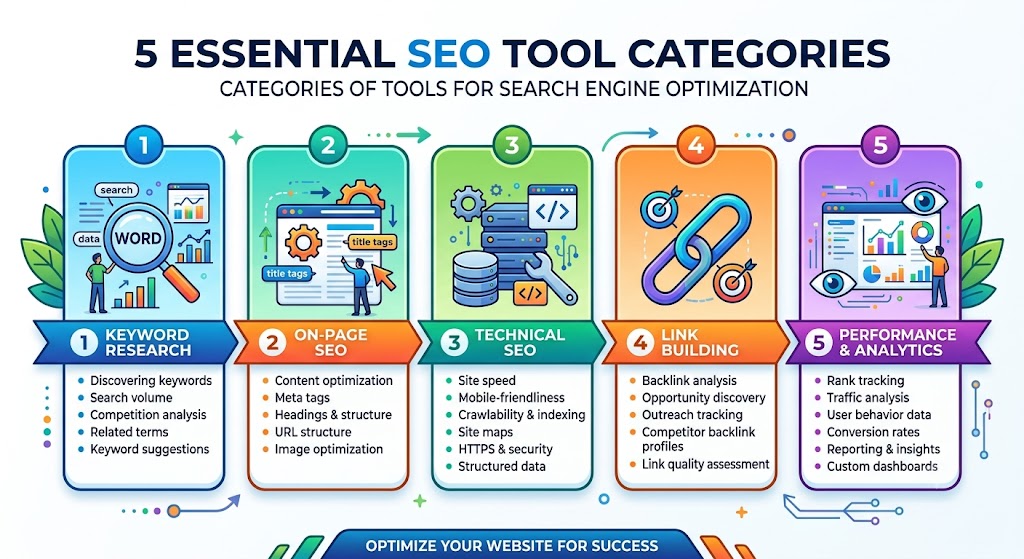
[Image suggestion: Infographic showing the 5 SEO tool categories with icons. Alt text: “SEO tool categories: keyword research, rank tracking, audits, content optimization, AI visibility”]
Our Methodology: How We Chose These Tools
Before diving in, here’s how we evaluated each tool for this list:
- Hands-on testing: Our team has used or currently uses each free and freemium tool listed here as part of our own SEO workflows.
- Feature-to-price ratio: We compared core capabilities against list price to flag tools that overcharge for basic features.
- Category leadership: Each “best for” designation reflects genuine category strength, not just brand popularity.
- Update cadence: We refresh this list at least twice a year to reflect new tools, pricing changes, and AI search developments.
This transparency section also gives you a natural place to link to an “About Us” or “Our SEO Process” page — a strong internal link for E-E-A-T.
Quick Answer (Featured Snippet Target)
The best SEO tools in 2026 include Google Search Console and WebFX SEO Checker for free auditing, Ahrefs and Semrush for competitor research and rank tracking, Surfer SEO and Clearscope for content optimization, and RevenueCloudFX for tying SEO performance directly to revenue. The right stack depends on your budget, team size, and whether you need an all-in-one platform or specialized point solutions.
What Are SEO Tools?
SEO tools are software programs that help you complete or improve a specific step in the search engine optimization process — from researching keywords to auditing technical issues to tracking rankings over time.
The best SEO marketing tools go beyond raw technical data — they connect optimization work to broader business goals like traffic, leads, and revenue.
SEO tools generally fall into these categories:
| Category | What It Does |
|---|---|
| Keyword research tools | Suggest relevant keywords and provide search volume, competition, and intent data |
| Rank tracking tools | Monitor where your pages (or competitors’) rank for target keywords |
| SEO audit tools | Analyze site health and flag technical issues hurting rankings |
| Content optimization tools | Suggest keywords, measure readability, and improve on-page content quality |
| AI search visibility tools | Track how your brand appears in AI Overviews, ChatGPT, and other generative answers |
| All-in-one SEO suites | Combine multiple SEO functions (keyword research, audits, tracking) in one platform |
Overview: The Best SEO Tools of 2026
| SEO Tool | Best For | Free / Freemium / Paid | Starting Price |
|---|---|---|---|
| WebFX SEO Checker | Free auditing | Free | Free |
| Google Search Console | Website performance monitoring | Free | Free |
| FAQFox | Content research | Free | Free |
| KeywordsFX | Keyword research | Free | Free |
| PageSpeed Insights | Page speed analysis | Free | Free |
| Lighthouse | Page performance & accessibility | Free | Free |
| Google Analytics 4 | Traffic & conversion tracking | Free | Free |
| Screaming Frog SEO Spider | Site crawling | Freemium | $259/year |
| WooRank | SEO grading | Freemium | ~$12.99/mo |
| Keywords Everywhere | In-browser keyword research | Freemium | ~$2.25/user/mo |
| Mangools KWFinder | Keyword difficulty scoring | Freemium | ~$29.90/mo |
| Ubersuggest | Budget keyword & competitor research | Freemium | Low-cost tiers |
| Ahrefs | Rank tracking & backlink research | Paid | $129/mo |
| Semrush | Competitor & technical analysis | Paid | $139.95/mo |
| Moz Pro | Large-scale SEO management | Paid | $49/mo |
| SE Ranking | Budget all-in-one suite | Paid | ~$65–$130/mo |
| BuzzSumo | Backlink/influencer research | Paid | $199/mo |
| Majestic | Link building & visualization | Paid | $49.99/mo |
| Raven Tools | Detailed SEO audits | Paid | $39/mo |
| SpyFu | Competitor analysis | Paid | $39/mo |
| Surfer SEO | Real-time content optimization | Paid | 10Essential Plan: $99/month ($79/month annually), including 30 Content Editor articles, 5 AI articles, 100 page audits, unlimited keyword research, and 2 team members |
| Clearscope | Editorial-quality content grading | Paid | 12The first and basic plan that Clearscope offers to its users is The Essentials which costs $189 per month |
| AccuRanker | Enterprise rank tracking | Paid | 17Starting at $224/month for 2,000 keywords |
| RevenueCloudFX | SEO ROI tracking | Paid | Custom pricing |
| Frase | AI content briefs & research | Freemium | Budget-friendly tiers |
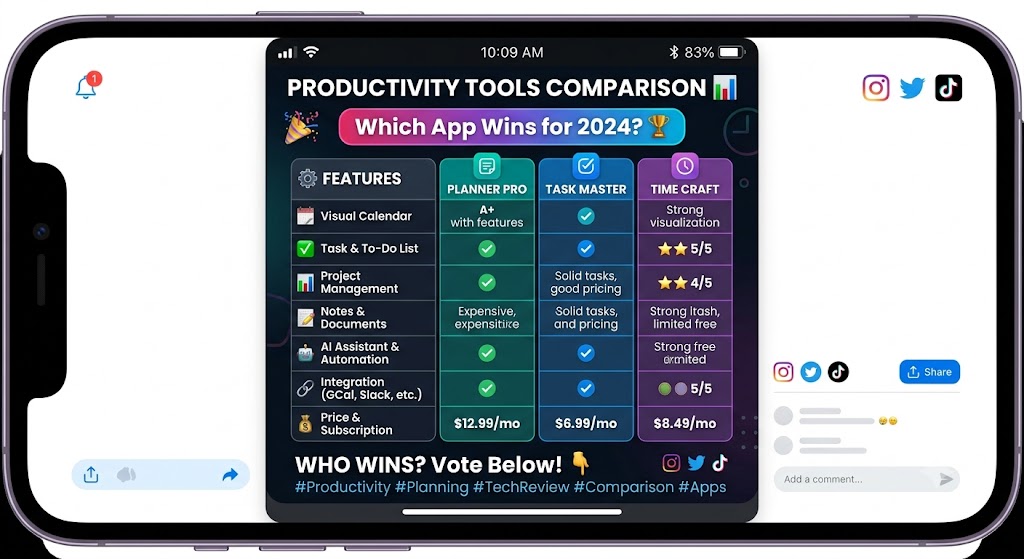
[Image suggestion: Screenshot-style comparison table graphic for social sharing. Alt text: “Comparison table of the best SEO tools by category and pricing in 2026”]
[CTA #1 — After Overview Table]
Not sure which tools fit your strategy? [Get a Free SEO Strategy Consultation →] (link to WebFX contact/consultation page) Our team will assess your site and recommend the right SEO tool stack for your goals and budget.
Best Free SEO Tools (2026)
Free tools are a great starting point if you’re building your SEO foundation without a big budget.
Best Free SEO Tool for Auditing: WebFX SEO Checker
Key features:
- Analyzes site speed, content optimization, links, and more
- Generates a full SEO audit report in minutes
Whenever you’re starting with SEO, an audit should be your first move — it shows you exactly where your site needs the most help. WebFX SEO Checker is beginner-friendly: simply enter your URL to get an analysis of your site speed, content optimization, code, links, security, mobile-friendliness, and crawlability.
[Internal link: Link “SEO audit” to your SEO audit services page] [Image: Screenshot of the WebFX SEO Checker dashboard. Alt text: “WebFX SEO Checker free audit tool dashboard”]
Best Free SEO Tool for Website Analysis: Google Search Console
Key features:
- Direct URL indexing requests
- Free keyword performance data and site issue alerts
Google Search Console lets you request indexing, get notified of site problems, and receive optimization suggestions — all for free. Paired with Google Search Analytics, it shows exactly how your target keywords are performing in search.
Best Free SEO Tool for Content Research: FAQFox
Key features:
- Crawls other sites to generate content topic ideas
- Helps identify what your audience is actually searching for
FAQFox crawls the web to surface real questions and topics your audience is discussing, giving you a data-backed starting point for content that satisfies search intent.
Best Free SEO Tool for Keyword Research: KeywordsFX
Key features:
- Unlimited keyword suggestions
- Exportable results
Enter a seed keyword and get a list of related terms to target — then export your results for later use in content planning.
Best Free SEO Tool for Page Speed Analysis: Google PageSpeed Insights
Key features:
- Full page speed report with lab data
- Diagnostics and improvement recommendations
Page speed directly affects bounce rate and rankings. Plug in a URL to see load-time data and specific opportunities to speed things up.
[Internal link: Link “page speed” to your page speed optimization services page]
Best Free SEO Tool for Auditing Performance & Accessibility: Lighthouse
Key features:
- Downloadable performance and accessibility reports
- Actionable improvement recommendations
This open-source Chrome extension audits a page’s accessibility, SEO status, security, and performance — and lets you export the results as a PDF or HTML report to track progress over time.
Best Free SEO Tool for Tracking Site Traffic: Google Analytics 4
Key features:
- Free reporting on user behavior, traffic, and conversions
- Time-based comparison for measuring campaign impact
GA4 helps you determine whether your SEO campaign is working by letting you compare metrics across time periods and visualize traffic trends.
[Internal link: Link “Google Analytics consulting” to your GA4 consulting services page]
[CTA #2 — After Free Tools Section]
Free tools got you started — now scale with expert help. [See How WebFX Uses These Tools to Grow Client Traffic →]
Best Freemium SEO Tools (Free Trials + Limited Plans)
Best SEO Tool for Crawling & Evaluating Site SEO: Screaming Frog SEO Spider
💸 Free version available; paid plans start at $259/year
Key features:
- Crawls your site (or competitors’) like a search engine bot
- Detects redirects, server errors, broken links, and duplicate content
Pros: Thorough technical diagnostics; works on competitor sites too; fast real-time feedback. Cons: Steeper learning curve for beginners; free version caps crawl limits at 500 URLs.
Best for: Technical SEOs and agencies needing deep-crawl diagnostics.
Best SEO Tool for Grading & Research: WooRank
💸 Free version available; paid plans start at $12.99/month
Key features:
- Instant SEO scoring for any website
- Feedback on mobile optimization and usability
Pros: Simple Chrome extension; useful for quick competitor snapshots. Cons: Less depth than dedicated audit tools for large sites.
Best for: Beginners wanting a fast, visual SEO score.
Best SEO Tool for In-Browser Keyword Research: Keywords Everywhere
💸 Free version available; paid plans start at $2.25/user/month
Key features:
- Search volume, competition, and CPC data directly in your browser
- Works across Google, Bing, and YouTube
Pros: Extremely affordable; low learning curve. Cons: Data depth is limited compared to dedicated keyword platforms.
Best for: Solo bloggers and small businesses needing quick keyword checks.
Best SEO Tool for Keyword Difficulty Scoring: Mangools KWFinder
💸 Free version available; paid plans start at $29.90/month
Key features:
- Keyword difficulty scores and search volume by location/language
- Related keyword suggestions with domain/page authority data
Pros: Clean, beginner-friendly interface. Cons: Keyword database is smaller than Ahrefs or Semrush.
Best for: Beginners targeting local or niche keywords.
Best Budget SEO Tool for Keyword & Competitor Research: Ubersuggest
💸 Freemium; low-cost paid tiers
Key features:
- Keyword suggestions, competitor domain overviews, and content ideas
- Site audit functionality
17 Ubersuggest is a budget-friendly SEO platform offering keyword research, site audits, and competitive analysis at 75-80% below enterprise tool pricing.
Pros: Extremely affordable entry point; simple UI for beginners. Cons: Less accurate/comprehensive data than premium platforms like Ahrefs or Semrush.
Best for: Solopreneurs and small businesses just starting SEO on a tight budget.
[CTA #3 — After Freemium Tools Section]
Ready to move beyond DIY tools? [Talk to an SEO Strategist About Your Growth Goals →]
Best Paid SEO Tools (For Teams and Scaling)
Best SEO Tool for Rank Tracking & Backlink Research: Ahrefs
💸 Starts at $129/month
Key features:
- Rank tracking, web monitoring, content/keyword research, competitive analysis
- Site Explorer for in-depth backlink analysis
- AI Content Helper and AI Content Grader for content optimization
Pros: Massive backlink index; excellent competitor gap analysis. Cons: Steep price for solo users; learning curve for beginners.
Best for: Agencies and in-house teams needing deep backlink and competitor data.
[Internal link: Link to your “backlink audit” service page]
Best SEO Tool for Competitor Research & Technical Analysis: Semrush
💸 Starts at $139.95/month
Key features:
- 50+ tools covering technical SEO, content, and competitor research
- Otterly AI integration for tracking AI search mentions
- ContentShake AI for content ideation and briefs
Pros: Broadest feature set of any all-in-one platform; strong AI visibility tracking. Cons: Highest price point on this list; can feel overwhelming for beginners.
Best for: Mid-size to large teams needing one platform for SEO, content, and AI visibility.
Best Budget All-in-One SEO Suite: SE Ranking
💸 Plans starting around $65–$130/month depending on tier
Key features:
- Rank tracking, keyword research, technical audits, backlink analysis, and content optimization in one platform
- Built-in AI search visibility tracking
11 Dramatically more affordable than dedicated content tools, SE Ranking provides a comprehensive SEO suite beyond content optimization — including rank tracking, technical audits, and backlink analysis, with AI search tracking included.
Pros: Strong feature-to-price ratio; consolidates multiple tools into one subscription. Cons: 11Offers only a 14-day free trial and no permanent free plan, while some competitors provide permanent limited free plans.
Best for: Agencies and small businesses wanting an all-in-one platform without enterprise pricing.
Best SEO Tool for Large-Scale SEO Work: Moz Pro
💸 Starts at $49/month
Key features:
- All-in-one suite covering crawling, keyword research, and campaign monitoring
- Local and national visibility reporting
Pros: Strong brand trust and Domain Authority metric recognition industry-wide. Cons: Keyword database and backlink index are smaller than Ahrefs/Semrush.
Best for: Large businesses needing a well-rounded, established platform.
Best SEO Tool for Backlink/Influencer Research: BuzzSumo
💸 Starts at $199/month
Key features:
- Influencer research by topic and industry
- Content performance and backlink opportunity discovery
Pros: Excellent for PR and digital PR-driven link building. Cons: Pricier than dedicated backlink tools for smaller sites.
Best for: Teams running digital PR and influencer outreach campaigns.
Best SEO Tool for Link Building & Visualization: Majestic
💸 Starts at $49.99/month
Key features:
- Site Explorer, backlink history checker, and search explorer
- “Topical Trust Flow” metric for authority benchmarking
Pros: Affordable; strong bulk backlink checking. Cons: Interface feels dated compared to newer competitors.
Best for: Link-building specialists needing affordable bulk backlink data.
Best SEO Tool for Detailed SEO Audits: Raven Tools
💸 Starts at $39/month
Key features:
- Paid site audits scoring 17 different SEO metrics
- Reporting for mobile, code, design, and layout issues
Pros: Affordable; strong reporting/readability. Cons: Smaller feature set than Semrush or Ahrefs.
Best for: Agencies needing white-label audit reports for clients.
Best SEO Tool for Competitor Analysis: SpyFu
💸 Starts at $39/month
Key features:
- Keyword and competitor research, backlink building, SERP analysis
- RivalFlowAI for content improvement suggestions
Pros: Affordable competitor keyword insights. Cons: Smaller index than Ahrefs/Semrush for large sites.
Best for: Small businesses wanting affordable competitor intelligence.
Best SEO Tool for Enterprise Rank Tracking: AccuRanker
💸 17Starting at $224/month for 2,000 keywords
Key features:
- Daily (and on-demand) rank updates across unlimited domains
- Strong segmentation for agencies managing multiple clients
Pros: 17Daily updates as standard, with unlimited users and domains across all tiers. Cons: 17Only does rank tracking, with API access requiring a much higher-tier plan, and no bundled full SEO toolkit.
Best for: Agencies tracking thousands of keywords across many client accounts.
Best SEO Tool for Monitoring SEO Performance & ROI: RevenueCloudFX
💸 Custom pricing
Key features:
- 20+ tools for search performance, lead nurturing, and ROI tracking
- ContentGeniusFX (IBM Watson AI-powered) for content creation and evaluation
RevenueCloudFX connects SEO performance directly to pipeline and revenue — monitoring search visibility (including AI search), tracking engagement metrics, and managing leads in one platform.
Pros: Ties SEO directly to revenue reporting; integrates with broader marketing stack. Cons: Best suited for businesses already working with a full-service marketing partner.
Best for: Businesses wanting SEO reporting tied directly to leads and revenue.
[Internal link: Link to your RevenueCloudFX product page]
[CTA #4 — After Paid Tools Section]
Want SEO reporting that ties directly to revenue? [See How RevenueCloudFX Connects SEO to ROI →]
Best AI Content Optimization Tools (New for 2026)
Content optimization is now one of the most competitive tool categories, thanks to Google’s growing emphasis on helpful, well-researched content and the rise of AI-generated search answers.
Best for Real-Time Content Scoring: Surfer SEO
💸 10Essential Plan: $99/month ($79/month annually). Includes 30 Content Editor articles, 5 AI articles, 100 page audits, unlimited keyword research (100 searches/day), and 2 team members.
Key features:
- Content Editor with real-time optimization scoring
- SERP Analyzer, keyword clustering, and an AI Tracker for AI search visibility
Pros: 10The real-time optimization scoring is Surfer’s genuine strength, with a Content Score that has a documented correlation with rankings. Cons: 6Add-on costs like the AI Tracker ($95/month) and SERP Analyzer ($29/month on Essential) push total costs well above the base price.
Best for: Content teams producing up to 30 optimized articles per month who want measurable, data-driven scoring.
Best for Editorial-Quality Content Grading: Clearscope
💸 12The Essentials plan costs $189 per month.
Key features:
- Content grading system (A++ to F) with keyword and question recommendations
- Minimal, distraction-free interface built for writers
Pros: 14The grading system gives writers a clear target to hit, which is why enterprise content teams use it to standardize quality across dozens of writers. Cons: 14Clearscope has no MCP server, no public API with documentation, and no native integrations with Claude or ChatGPT, so you’ll rely entirely on manual workflows.
Best for: Enterprise editorial teams prioritizing content quality and writer consistency over automation.
Best Budget AI Content Brief Tool: Frase
💸 Budget-friendly tiers below Surfer/Clearscope pricing
Key features:
- AI-generated content briefs and SERP research
- Question-and-answer data pulled from top-ranking pages
Pros: More affordable entry point than Surfer or Clearscope. Cons: Less robust scoring/grading system than premium competitors.
Best for: Small teams and freelancers needing AI-assisted briefs without enterprise pricing.
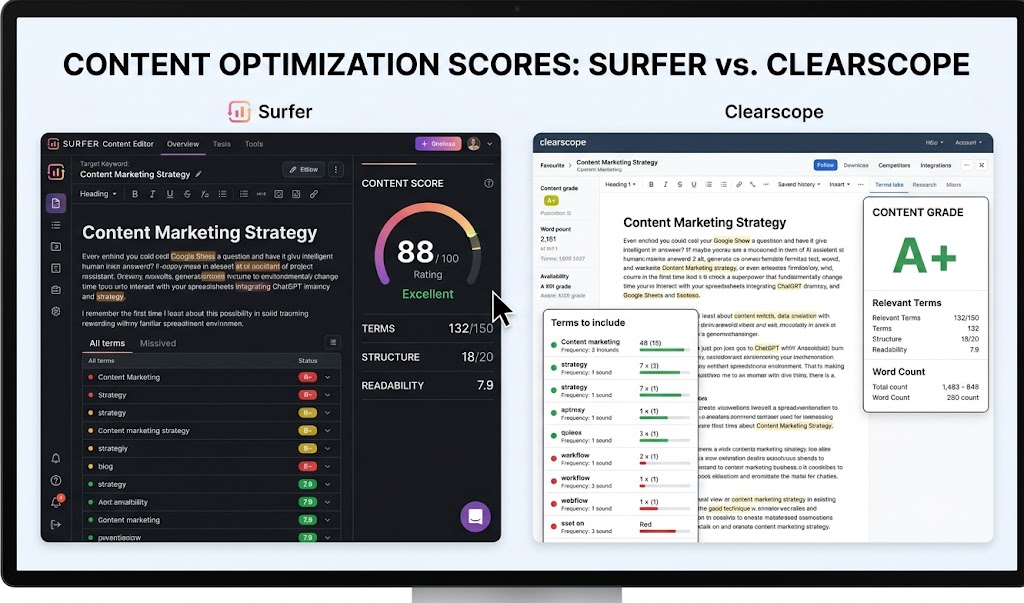
[Image suggestion: Side-by-side screenshot comparing Surfer’s Content Editor score vs. Clearscope’s content grade. Alt text: “Surfer SEO vs Clearscope content optimization score comparison”]
AI SEO Tools & AI Search Visibility Tracking (2026)
AI-powered search features — like AI Overviews and chat-based generative answers — are changing how SEO performance gets measured. Rankings alone no longer tell the full visibility story, so a growing category of tools now tracks how brands and content appear inside AI-generated responses.
Top AI Search Visibility Tools in 2026
- Semrush (Otterly AI): Tracks brand mentions and sentiment across AI platforms like Perplexity and ChatGPT, and automatically tracks URLs cited in AI Overviews.
- Ahrefs: Strengthens topical authority signals that influence AI search visibility, and lets you check whether your pages show up in AI Overviews via Site Explorer.
- Surfer SEO (AI Tracker): 2Helps you track, measure, and improve your AI visibility with clear insights on your Visibility Score, mention gaps, and competitor share of voice.
- SE Ranking: Includes AI search tracking as part of its all-in-one suite, replacing standalone AI monitoring tools for agencies on a budget.
- RevenueCloudFX: Connects AI-influenced search visibility directly to conversions and revenue reporting.
[CTA #5 — After AI SEO Section]
AI search is changing how customers find you. [Get a Free AI Search Visibility Audit →]
How Do You Choose the Best SEO Tools?
Use this simple decision framework:
- Define your primary goal. Are you auditing technical issues, researching keywords, tracking rankings, or optimizing content?
- Match your budget. Solo bloggers should start free (Google Search Console, KeywordsFX); growing teams should consider freemium options (Keywords Everywhere, Ubersuggest); agencies and larger teams typically need paid, all-in-one platforms (Semrush, SE Ranking, Ahrefs).
- Consider your experience level. Beginners benefit from simpler, guided tools like WooRank or Mangools KWFinder before graduating to more complex platforms.
- Factor in AI search visibility. If competitive rankings alone no longer explain your traffic trends, add an AI visibility tracker (Otterly AI, Surfer AI Tracker, or SE Ranking) to your stack.
- Don’t over-buy. Most businesses don’t need every category covered by paid tools — start with one strong all-in-one platform and add specialized tools (like a dedicated content optimizer) only once you’ve outgrown the basics.
Which SEO Tools Work Best for My Industry?
(Keep your existing accordion structure here, but expand each into a real mini-section — this is a strong internal linking and long-tail keyword opportunity.)
Recommended expansion for each industry accordion:
- 2-3 recommended tools specific to that industry’s SEO challenges
- A short paragraph explaining why (e.g., ecommerce needs product schema + large-scale rank tracking; healthcare needs strict E-E-A-T-focused content tools)
- An internal link to your industry-specific SEO service page
Example (Ecommerce):
For ecommerce sites, prioritize tools that handle large-scale rank tracking (SE Ranking, AccuRanker) and product-page content optimization (Surfer SEO). Pair these with [WebFX’s ecommerce SEO services] for hands-on strategy support.
Frequently Asked Questions
What is the best free SEO tool in 2026? Google Search Console remains the best free SEO tool overall because it provides direct keyword performance data, indexing control, and site health alerts straight from Google — the search engine you’re optimizing for.
Do I need paid SEO tools, or are free tools enough? Free tools are sufficient for basic audits and keyword ideas, but paid tools like Ahrefs and Semrush provide deeper backlink indexes, competitor data, and rank tracking that free tools can’t match — especially for competitive industries.
What’s the difference between Ahrefs and Semrush? Ahrefs is generally considered stronger for backlink analysis and its Site Explorer feature, while Semrush offers a broader all-in-one toolkit spanning technical SEO, content, PPC, and AI search tracking through Otterly AI.
Are AI SEO tools worth it in 2026? Yes — as AI Overviews and generative answers capture more search traffic, tools that track AI visibility (like Otterly AI or Surfer’s AI Tracker) help you understand a growing share of your search performance that traditional rank trackers miss.
Which SEO tool is best for beginners? WooRank and Mangools KWFinder are both beginner-friendly, offering simple scoring systems and guided keyword research without overwhelming dashboards.
How much should a small business budget for SEO tools? Small businesses can start free with Google Search Console and KeywordsFX, then budget $50–$150/month for a freemium or entry-level paid tool like Ubersuggest or SE Ranking as they scale.
[This FAQ section is designed for FAQPage schema markup — see technical recommendations below.]
Optimize Your SEO Strategy With WebFX
The best SEO tools help you audit your site, track performance, and improve ROI — but tools alone don’t build a strategy. If you need expert guidance turning this data into results, WebFX can help.
Our team combines industry-leading SEO tools with hands-on strategy, taking the time to understand your business, industry, and audience to build an SEO plan suited to your goals and budget.
[Final CTA]
Ready to turn SEO tools into real growth? [Get Your Free SEO Proposal →] | [Speak With an SEO Strategist Today →]
SUPPORTING CMS RECOMMENDATIONS
1. Schema Markup to Implement
| Schema Type | Where to Apply | Purpose |
|---|---|---|
Article / BlogPosting | Full page | Include datePublished and dateModified for freshness signals |
ItemList | Overview table / tool list | Helps Google understand the 25 ranked tools as a structured list |
FAQPage | FAQ section | Enables FAQ rich results in SERPs |
BreadcrumbList | Page navigation | Improves SERP breadcrumb display |
Organization | Site-wide | Reinforces WebFX as the publishing entity for E-E-A-T |
Note: Only implement AggregateRating/Review schema if you assign genuine, methodology-backed scores — fabricated ratings violate Google’s structured data guidelines.
2. Internal Linking Map
| Anchor Text | Links To |
|---|---|
| “SEO audit” | SEO audit services page |
| “page speed optimization” | Page speed services page |
| “Google Analytics consulting” | GA4 consulting services page |
| “backlink audit” | Backlink audit/link building services page |
| “RevenueCloudFX” | RevenueCloudFX product page |
| “ecommerce SEO services” | Industry page: Ecommerce SEO |
| Each industry accordion | Corresponding industry SEO service page |
| “Our SEO Process” (methodology section) | About/Methodology page |
3. Image Plan (with Alt Text)
- Featured image — collage of tool logos → “Collage of top SEO tools for keyword research, audits, and rank tracking in 2026”
- Category icons infographic → “SEO tool categories: keyword research, rank tracking, audits, content optimization, AI visibility”
- Comparison table graphic → “Comparison table of the best SEO tools by category and pricing in 2026”
- Tool dashboard screenshots (one per major tool) → “[Tool name] dashboard screenshot showing [specific feature]”
- Surfer vs. Clearscope comparison graphic → “Surfer SEO vs Clearscope content optimization score comparison”
Technical note: Compress all images (WebP format) and lazy-load below-the-fold visuals to protect Core Web Vitals on this long-form page.
4. On-Page UX Enhancements
- Add a sticky table of contents with jump links at the top of the article (critical for a 24-minute read).
- Add a “Jump to comparison table” anchor link directly under the H1.
- Consider a “Which SEO tool fits you?” interactive quiz widget near the decision-framework section to boost engagement and capture lead data.
5. Lead Generation Enhancements
- Add a downloadable lead magnet: “Free SEO Tool Stack Checklist” (gated PDF, email capture) linked after the Overview Table.
- Ensure all 5 CTAs above link to distinct, relevant landing pages (not just one generic contact page) to improve conversion tracking and attribution.
- Add a testimonial/stat block (e.g., client organic traffic growth %) near the final CTA to reinforce social proof before conversion.
CMS-Ready Blog Post: The 25 Best SEO Tools to Boost Organic Traffic in 2026
Below is the fully rewritten, SEO-optimized, publish-ready version of your blog post, followed by all supporting CMS metadata (meta title/description, schema, internal linking map, and image alt text). I’ve expanded the list to 25 tools (adding the 6 critical gaps identified in the audit), added pros/cons, a methodology section, FAQ schema content, and 5 strategically placed CTAs.
CMS METADATA (add these fields in your CMS before publishing)
Meta Title (58 characters): 25 Best SEO Tools to Boost Organic Traffic in 2026
Meta Description (155 characters): Compare the 25 best free, freemium & paid SEO tools of 2026 for keyword research, audits, rank tracking & AI search visibility. Find your fit.
URL Slug: /blog/best-seo-tools
Last Updated Date to Display: Updated: July 2026 (update this timestamp every time you refresh the list — this is a freshness/trust signal for both users and Google)
Suggested Featured Image: A flat-lay or dashboard collage graphic showing 5-6 recognizable SEO tool logos/interfaces arranged around a magnifying glass icon. Alt text: “Collage of top SEO tools for keyword research, audits, and rank tracking in 2026”